Janet wanders the chiaroscuro corridors of a disordered mind, her sanity never far removed from the madding crowd. Freddie Francis directs this fearful tale of a young woman consumed with the fear of inheriting her mother’s mental illness, and still suffering the vertiginous trauma of domestic violence.
Francis directs the film but must have greatly influenced every Scope composition as it bears his intense and intriguing visual signature. The imbalanced and schizophrenic structure that leads to an EC Comics style payoff is less seducing than the cinematography, the wonderful mise-en-scene and deep focus photography, which allows characters to stay in focus as they disappear from the screen like ghosts. Bold lighting effects transform a mansion into a gothic sepulcher, with ghastly shadows haunting the walls and disembodied voices whispering hushed secrets from beyond. It also sports one of the creepiest dolls ever, its plastic face a malignant chorus of silent accusation.
The first half of the story focuses upon Janet, a teenager whose visceral nightmares carry the viscous weight of reality, and soon she fails to differentiate the two. Her past trauma is revealed and soon we learn the secret: she has been manipulated into madness and murder. The second half concerns those responsible and it immediately becomes evident that someone is intent upon poetic justice. The story remains intriguing and intense while Janet treads the dark waters of sanity, but becomes mundane when the crime is revealed. The usual suspects are so unlikable and shrill that the only pleasure is in discovering who is taunting them, playing them against one another: unfortunately, it’s not very difficult to guess. NIGHTMARE is a minor thriller that shines with elegant black and white cinematography. Final Grade: (B-)
 Penny is seemingly a young girl whose thoughts are worth a great deal more than a copper cent, her dexterous mind imprisoned in a crippled tomb of flesh and bone. Seth Holt directs a deft little thriller whose labyrinthine twists lead through a gothic mansion of murderous intent and end upon the crashing surf.
Holt begins the first act with a dark haired young girl being pulled from a lake, the Alps rising above the scenario like some Olympian requiem. Her dead face remains hidden, a claw like hand groping towards the heavens, her identity revealed as only a shock of black hair sticking out from under a tarp. Holt then jump cuts to a jet plain landing in France and we witness out protagonist, a raven haired beauty confined to a wheelchair. This ambiguity propels the story: are we seeing a flashback that will lead to her demise, the plot now concerned with the facts of the possible crime?
Douglas Slocombe’s striking cinematography creates an eerie disjointed atmosphere and help the mystery enter deep waters, utilizing deep focus to highlight foreground elements while revealing subtle information in the background. Strange candles whose light flickers like demon tongues, triptych compositions that in retrospect contain key objective evidence, and underwater photography whose ghastly elements shock and awe. The soundtrack is embedded with the annoying habit of chirruping crickets and singsong birds, helping the audience to delineate night and day in this colorless film. In one indoor scene, Penny and her Stepmother are having dinner and their contentious conversation ebbs to reveal crickets…inside the house. The acting is first rate with Christopher Lee subverting expectations, and Susan Strasberg perfectly capturing the dichotomy of emotional reactionary and masterful proactivity.
The narrative is awash with red herrings but remember: in water, no one can hear you scream! Final Grade: (B+)
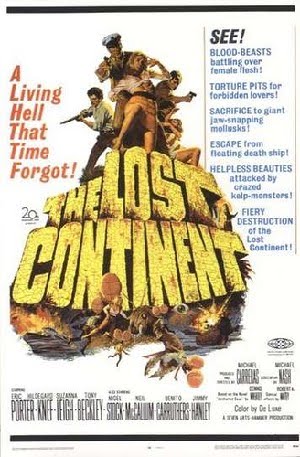
 A tramp steamer transports a cargo of explosives, a chemical admixture secreted in the watertight hold and a group of conflicting personalities, all about to detonate. Michael Carreras directs this conglomeration of fantasy and melodrama which is barely kept afloat by the hot air of imbecilic imaginations.
Carreras’ film wastes the first half by focusing upon a group of fugitive characters, each revealing their sordid past and the reason they chose to escape from Africa on this rusting hulk: a Doctor and his nymphomaniacal daughter, an aging and once famous actress, a mysterious dark haired man, and the ubiquitous alcoholic. The Captain orders his crew full steam ahead, outrunning customs and making for the open sea even as he ignores a Hurricane warning. Carreras often films the characters in close up sheathed in sweat, creating a grimy atmosphere that distances the audience from any compassion, as if their inner guilt is painted upon faces. The fault here is that the characters remain unlikable, and we remain more concerned with getting to the fantasy elements.
Eventually the ship is plot-bound in the Sargasso Sea, the killer kelp and sentient seaweed clutching dangerously at their flesh, the seascape haunted by the ghosts of aging ships that loom like dinosaur skeletons in the ominous mist. The crew become victims of a religious war between buxom land dwellers and descendants of the Inquisition, who hold dominion over the tangled morass. They walk on inflatable boots, their shoulders tethered with balloons to keep from sinking into the living mass, but it’s all very silly: why didn’t someone just make a big balloon and float away? Though the rubber monsters are built to scale (this would have benefited from Harryhausen’s magic!) and the costumes are cheesy, there remains a certain charm to the drama, partly because the actors play their part perfectly straight, full of vigor and vinegar.
The confusing part to the entire plot is that there is no continent: Sara the busty stranger alludes to her people living on land but it is never revealed, so the film’s title becomes amusing. Well, maybe the lost continent is so lost that even the story can’t find it! THE LOST CONTINENT is narratively incontinent. Final Grade: (C-)
 Gwen revives from a spiritual breakdown and is offered a second chance to teach in an idyllic rural village, her wealthy benefactor a man with a collar, not a leash. Director Cyril Frankel teams with the legendary actress Joan Fontaine to produce a suspenseful drama whose titular advertisements reveal the mystic spectacle, but nonetheless remains an enjoyable ballet of black magic. The story begins with thunderous rhythms as Gwen prepare to depart her school in Africa, when suddenly she is assaulted by a Witch Doctor armed with a fetishistic mask, sacrificial blade and some Lovecraftian sorcery. She blacks out and the story jumps forward a few months as she is being interviewed for another teaching job, questions of her mental breakdown a contentious moment of brevity. Gwen soon finds herself in an ideal setting, with friendly folk who readily accept her into the fold.
The plot quickly jettisons exposition and allows the story to build slowly towards its expected resolution. A nice visual flares involve the local Butcher skinning a rabbit while holding a genial conversation with Gwen, but his wife’s look seems to hold back some dark foreboding knowledge: not only is this scene bloody and raw, it serves as a metaphor for Gwen’s status in the community and also foreshadows the wife’s actions.
Two young lovers are scorned and driven from one another, leaving the virginal young lady as a spell component for the mysterious High Priestess. The climactic ritual juxtaposes Satanism in the Western World with the primitive magic revealed in the opening scenes, and the sight of cavorting and orgiastic cultists eating feces and striking poses is both hilarious and slightly disarming: like a cross between Pasolini’s SALO and Adrian Lyne’s FLASHDANCE.
Immortality is written in Latin but empowered by the goblin of hemoglobin, and Gwen saves two souls with her own blood offering. Final Grade: (B-)
 A woman on the verge of another nervous breakdown seeks emotional shelter in a quicksilver marriage, where murder is just a shot away. Hammer regular Jimmy Sangster’s foray into Hitchcockian territory travels the beaten path of genre cliché, a boilerplate narrative whose plot devices become a genre vice. The story, like all Hammer Productions, uses a formulaic narrative economy that propels one scene to the next without exposition or transition: usually a positive, here it stalls the suspense while committing film’s greatest sin…it becomes boring.
Without regurgitating the entire plot, a few diabolical moments help the film become barely risible, conveying inspiration and lost potential. Peggy’s first attack by the one-armed person is considered delusional, a symptom as she is still recovering from her breakdown (whose explanation is never revealed), by people uninvolved in the complicated plot. This seems unreasonable, and Sangster could have structured the film as police procedural, building razor-wire tension until the shotgun climax. Instead, everyone is condescending towards Peggy and she becomes a caricature, a walking and talking narrative element as opposed to a three dimensional fiction. This is the basic flaw of the movie. Sangster also cross-cuts Peggy’s ordeals with her mysterious counseling sessions, her doctor’s face never revealed. Again, this is a wonderful setup for an ironic twist but this participle remains dangling.
The story travels to a deserted Boy’s School where disembodied voices echo throughout the hollow rooms, a place where hunched and ghostly forms haunt each room, and a lonely Headmaster wanders the convolutions of this deserted manor. The story fails again to generate much suspense and becomes too talky, relying on exposition instead of superstition. Peter Cushing as the Headmaster and Joan Collins as his predatory wife are woefully underwritten: though each is excellent in their allotted roles, they never appear in scene together. Joan Collins becomes a minor figment in this disillusioned story that descends from the briefly profound to the prosaic.
FEAR IN THE NIGHT has little of either, and the whole is a confection that is unfulfilling and full of empty calories…without sweet rapture.
Final Grade: (C-)
 The Black Death poisons a rural village with metaphysical fear, as the locals turn a blind eye occluded by superstitious dread. But a stranger brings a neurotoxin to suppress the investigative paralysis and discover the cause of his brother’s demise, leading him and his wife into direct confrontation with the Queen Cobra.
John Gilling directs a murder mystery whose riddle is given away by the film’s title, but exposes interesting details bite by bite, building limited suspense and frisson. The gruesome Reptile isn’t revealed until the final act, so Gilling bides time by creating narrative tension between Harry, the new kid in town, and the wealthy recluse Dr. Franklyn. Harry Spalding inherits his brother’s home and moves in with Valerie his new bride, and together they must face a series of strange characters and attitudes. From the local drunk Mad Peter, hilariously possessed by actor John Laurie whose supper invitation is the film’s highlight, to a shy but repressed brunette who wanders into their abode unannounced with a bouquet of orchids, the Spaldings begin to realize that death here is communicable but the Bubonic plague isn’t responsible.
The story leads to false presumptions, a somewhat clever bait and switch that reveals the true villain as a minor character kept mostly in shadow, and the Franklyn’s raven haired daughter as a victim of a venomous cult. Transformed permanently into Ophiophagus hannah, Anna sheds her skin and brumates near a sulpher spring (because what Victorian mansion isn’t complete with dungeon and bubbling sulpher spring?) and awaits the coming of Spring. But Valerie is imbued with a feminist bravado and seeks answers of her own, and trapped in the burning mansion is saved by nature’s cold breath. Final Grade: (C)
 Janet wanders the chiaroscuro corridors of a disordered mind, her sanity never far removed from the madding crowd. Freddie Francis directs this fearful tale of a young woman consumed with the fear of inheriting her mother’s mental illness, and still suffering the vertiginous trauma of domestic violence.